
Technology
Sarasota County family shares journey after pioneering in-womb spina bifida repair
By Marcus Chen
Advertisement · Why this ad?
Katherine oversees editorial operations across all six brands. Before joining The Meridan Group, she spent 14 years at the Minneapolis Star Tribune, where she led the metro desk through its digital transformation. She holds a Master's in Journalism from Northwestern's Medill School.
More from Katherine →
The image of a packed team bus lumbering down a highway, a stark alternative to the swiftness of air travel, became a jarring reality Friday as a nationwide Federal Aviation Administration (FAA) ground stop brought the sports world to a standstill. The disruption, triggered by a temporary telecommunications outage, impacted everything from college football road trips to NBA schedules and NHL destinations, leaving teams scrambling and fans anxiously awaiting updates. The ripple effects of this unprecedented event are certain to be felt across the region, impacting not only the games themselves but also the livelihoods of those who depend on them.
The FAA issued a nationwide ground stop Friday afternoon, effectively halting all departing flights across the country. According to the FAA, the action was taken due to a “temporary telecommunications outage” impacting air traffic control centers. Transportation Secretary Sean Duffy assured the public that the stoppage was not related to safety concerns, emphasizing that it was a precautionary measure to ensure operational integrity. The agency has not yet released a timeline for when flights will resume, leaving numerous sporting events in jeopardy. Department of Homeland Security Secretary Markwayne Mullins reassured reporters that the ground stop issuance was not because Americans' safety were at risk, stating, “We have a ground stoppage, we still got to get the flights out.”
The immediate impact was felt acutely by college football teams preparing for weekend games. Notably, No. 2 Utah, eighth-ranked Texas, and No. 9 Tennessee were among those affected, their travel plans thrown into disarray. The Longhorns, scheduled to play No. 24 LSU Saturday evening, had even boarded their plane before the ground stop went into effect. A team spokesman stated, “We are grounded and waiting to see when we can leave.” Texas would have faced a seven-hour bus journey to Baton Rouge for the 6:30 p.m. CT kickoff if they had opted for that mode of transportation. Tennessee, similarly, had returned to campus awaiting further instructions. Auburn and Purdue opted to take buses to Mississippi State and Iowa respectively, demonstrating a pragmatic response to the unexpected situation.
Beyond college football, the stoppage impacted professional leagues as well. The Nets, who had just boarded their team plane in New Orleans following a game against the Pelicans, were halted mid-flight en route to Memphis. The Pistons flew earlier in the day to Miami, while the Cavaliers, Bulls, and Grizzlies were due to fly afterward. The Cavaliers played in Miami on Friday night and were scheduled to play the Mavericks at home Saturday. Cleveland coach Kenny Atkinson said about 90 minutes before tip-off that his team was scrambling to find hotel rooms in Miami for Friday night, just in case. “It’s part of it. You just adapt,” Atkinson said.
San Jose State’s football team had boarded a plane for its trip to Air Force when the plane turned around and went back to the gate. The team returned to campus and was waiting to see what happens. Several NHL teams experienced similar delays, with the Sharks waiting in San Jose to determine if they could travel to Utah. The Big Ten confirmed that all scheduled officials for Saturday’s games had arrived, providing a small measure of stability amidst the chaos.
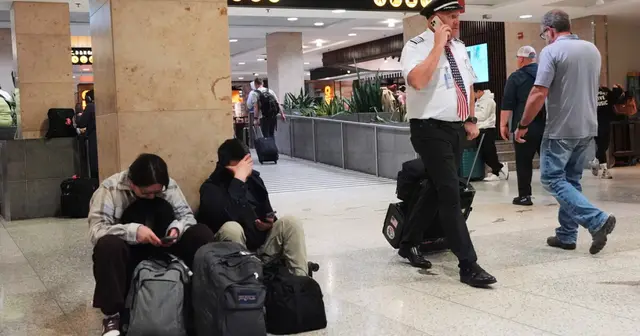
The news of the FAA ground stop reverberated throughout the Tampa Bay area, particularly impacting Tampa International Airport (TPA). As reported by Tampa Bay 28, TPA halted all departing flights, with inbound flights able to land. Hundreds of flights were delayed and trams to the terminals were stopped, though en route planes could still land. By 6:20 p.m., the airport reported 194 of its 534 flights were delayed and 31 were canceled. The airport asked travelers to contact their airlines for the latest information on their flights.
The ground stop’s impact on TPA was significant, with airport officials advising travelers to contact their airlines for updates. The airport closed shuttle lobbies to airside terminals as terminals reached capacity. The disruption highlighted the importance of contingency planning and the potential economic consequences of widespread travel delays. The FAA’s explanation of a “temporary telecommunications outage” offered little immediate reassurance to stranded passengers and anxious travelers. Tampa Bay 28 reported that officials are asking travelers to contact their airlines for the latest information on their flights.
The uncertainty surrounding the resumption of flights casts a shadow over upcoming sporting events. While some teams managed to depart before the ground stop, others face significant challenges in reaching their destinations. The NFL’s Week 10 schedule, along with men’s and women’s college basketball games, remain in a state of flux. JuJu Watkins and her Southern California teammates, attempting to reach South Carolina for a Sunday game against the top-ranked Gamecocks, were forced to deboard their plane at Los Angeles International Airport and return to the Galen Center. The incident serves as a stark reminder of the fragility of logistical planning in a world increasingly reliant on air travel.
The long-term implications extend beyond immediate game schedules. The incident will undoubtedly prompt a thorough review of air traffic control systems and contingency plans to mitigate the risk of future disruptions. For some of the NFL teams, trips via bus would be manageable: Pittsburgh plays at Cincinnati, the Los Angeles Rams play at Arizona, Minnesota is visiting Green Bay, and Buffalo is scheduled to play the Jets in East Rutherford, New Jersey.
Witnessing the chaos unfold across the sports world reminds us that even the most meticulously planned events can be derailed by forces beyond our control. While the immediate inconvenience for athletes and fans is undeniable, this situation also offers a valuable opportunity for reflection. The reliance on air travel, while efficient, creates a vulnerability that we must acknowledge and address. It’s a stark contrast to a time when families often traveled together by car, strengthening bonds and creating lasting memories. The disruption also highlights the importance of strong local communities – the ability of teams to adapt and find alternative solutions, whether it's a bus ride or a last-minute hotel booking, is often rooted in the support and resourcefulness of those around them. I hope this incident prompts a broader conversation about the balance between convenience and resilience, and the enduring value of community connection in an increasingly mobile world. We should also consider the emotional toll on young athletes, already under immense pressure, when their carefully laid plans are abruptly overturned. It’s a reminder that faith, family, and a steadfast spirit are essential, not just on the field, but in navigating life’s unexpected detours.
Resources for travelers affected by the ground stop can be found at Tampa International Airport and through their respective airlines. The FAA is providing updates on its website, though a timeline for restarting flights remains unclear. As we move forward, it’s crucial that we prioritize safety and preparedness, while also recognizing the importance of human connection and community support in times of disruption.
The events of Friday serve as a reminder that even in an age of technological advancement, the unpredictable nature of life remains a constant. The swift recovery and resilience displayed by teams and communities alike offer a glimmer of hope amidst the disruption, and a renewed appreciation for the importance of planning, preparedness, and unwavering faith.
By Marcus Chen
By Marcus Chen
By Katherine Langford

By Katherine Langford